
What Hopkins County Deed Records Show by Instrument Type
Every deed that changes hands in Hopkins County passes through the County Clerk. The Clerk records and preserves these instruments along with mortgages, releases, liens, easements, rights-of-way, and plats. The instrument type tells you the form of the transfer. The parties, date, legal description, and record reference tie that act to a specific tract. Keeping those pieces straight helps you read a Hopkins County deed record. You can avoid mistaking a lien or easement for a sale. For access, the Clerk's legal-records page is the county's gateway to deed records. It also offers the TitleSearcher route.
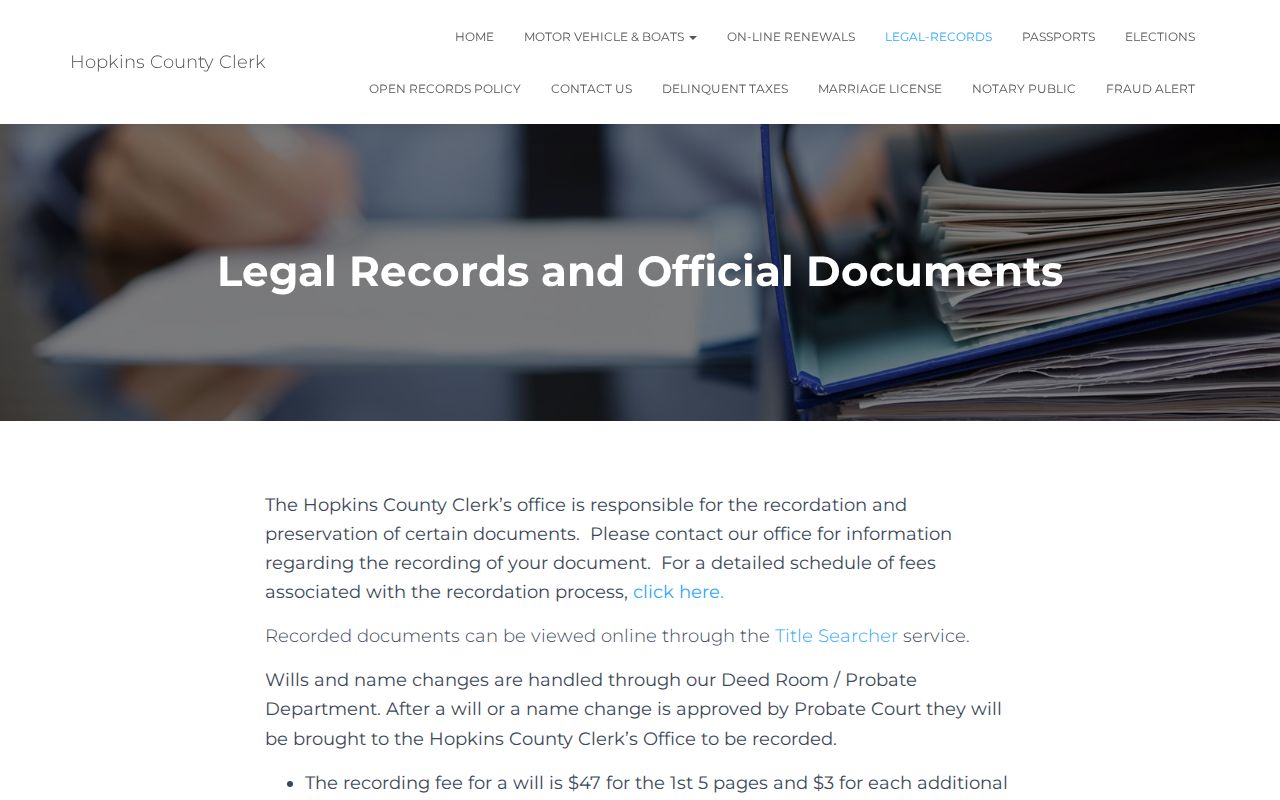
Note: The Clerk's legal-records page lists the access routes and confirms the clerk as custodian of every recorded instrument and certified copy.
| Deed Type | What It Does | Common Use |
|---|---|---|
| Warranty deed | Conveys the stated interest with deed covenants | Ordinary purchase transfer |
| Quitclaim deed | Conveys whatever interest the grantor has | Family transfer or interest cleanup |
| Executor or administrator deed | Conveys through an estate fiduciary | Transfer tied to probate authority |
| Commissioner or sheriff deed | Conveys under court or statutory process | Judicial sale or enforcement |
| Correction deed | Corrects a stated flaw in an earlier instrument | Name or description correction |
The legal-records page links out to TitleSearcher. That is a private hosted vendor. The clerk stays the custodian of record, though. The office sits at 24 Union Street in Madisonville. Staff there can answer questions about copies, certifications, deed books, plat books, the index, and probate routing. Wills and name changes take a different path. They move through the Deed Room and Probate route once a court approves them.
When an estate sits in the chain of title, connect the probate authority to the executor, administrator, commissioner, or other fiduciary deed. Then verify the recorded legal description against the probate file.
Walk the Hopkins County Grantor-Grantee Index
Building a chain of title means repeating one name-and-reference search over and over. Start from a known owner drawn from the parcel or tax record. A name match alone never identifies land. TitleSearcher's public help notes a quirk worth knowing. A start date alone searches forward, while an end date alone searches backward from 2000. Set a range on both sides instead.
- Search the current owner as grantee within a useful date span.
- Open the likely acquisition deed and match its legal description, map clue, and prior reference.
- Record the grantor exactly, then search that party as grantee to step back.
- Search both parties as grantors to uncover later or partial conveyances.
- Continue in deed books or microfilm when the online trail stops.
- Grantor
- The party conveying the stated interest.
- Grantee
- The party receiving that interest.
- Chain of title
- The linked sequence of instruments affecting one tract.
- Book/Page vs Instrument #
- The clerk's locator for a recorded document.
Neither the county nor the vendor publishes the earliest online deed year for Hopkins County. Treat any claim you hear as unverified. Kentucky Department for Libraries and Archives guidance describes deed-book holdings running generally from 1781 through 2018. Availability varies by county. Confirm a Hopkins volume with the clerk or KDLA before relying on it. The TitleSearcher landing screen documents the vendor-controlled login and access route the county uses.
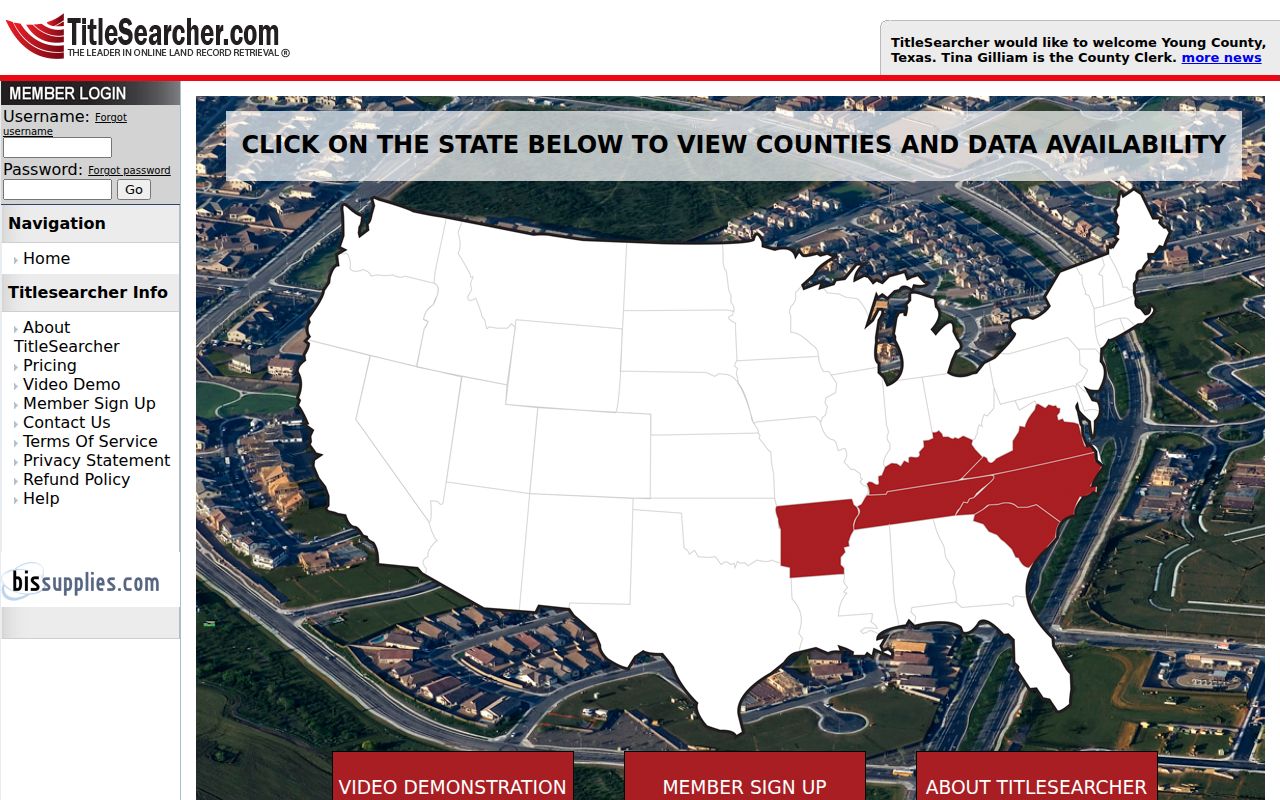
Only a live Hopkins session shows the full index fields. It also shows the county coverage the vendor provides. Cross-reference and refer-back links can surface an earlier instrument. That link is often the whole game. Match three things before adding a deed to the chain. Check the party names, the land description, and the record reference. Keep trust, estate, company, and marital wording intact. Note whether the deed conveys all or only part of a parent tract.
For lot-and-block land, preserve the subdivision, section, unit, lot, block, plat book and page, and any amendments. For metes and bounds, keep the calls, bearings, distances, monuments, adjoining owners, water or road references, and exceptions. A street address cannot stand in for any of that.
Read the Hopkins County Deed Index Result as a Lead
Treat every index result as a lead, not a conclusion. A careful inventory records the search mode and the exact query name. Note the dates, county, and document type. Record the grantor, grantee, and recording date. Include the instrument or book-and-page reference, the consideration if shown, and any legal-description clue. Finish with the prior reference, the image format, and the certification status. The vendor displays result details only inside a logged session, so no public sample exists. Save the row before opening the image. Verification can change what the result appears to say. A certified image with its full legal description always outweighs the index line. Some land carries an older map label. Keep it beside the modern account and address. Do not replace it.
Connect Hopkins County Plats and Easements to the Deed
Recorded plats establish the lot, block, subdivision, dedications, and any amended layout a deed references. Easements and rights-of-way can define access or reserved use that the parcel outline never shows. Pull the linked instruments and preserve their exceptions. Assume nothing about rights from a map alone.
Dawson Springs offers useful historic context. Its 1898 plat and the 1909 Sanborn expansion along Railroad, Arcadia, and Main help align an old block with a modern DS-style tax-map clue. The recorded deed and plat still control.
Handle Probate Transfers in Hopkins County Deed Records
A death certificate or a will explains why a name enters the chain, but neither one proves the land actually moved. Follow the decedent into the probate file first. Identify the fiduciary or court authority. Then find the executor, administrator, commissioner, or other recorded deed that carried out the transfer.
Collateral records matter too. Older marriage records live with the county clerk, while older divorce files sit with the Circuit Clerk. Both can explain name variants. Neither replaces the operative land instrument.
Bridge Historic Hopkins County Deeds across Record Sets
Continuity across Hopkins County record sets often hinges on a single cross-reference. It might be a deed's cited prior deed. It might be a plat's parent tract or a probate order's description. It could be a tax roll's map label. Or it might be a newspaper notice carrying a book and page. Capture it word for word before modernizing any name or address.
Madisonville forms a practical records hub. The clerk, PVA, Justice Center, GIS offices, library, and Historical Society all sit within reach. The county reported a document-preservation grant above $33,000 in 2014. That shows real preservation work happened. It does not prove every volume survives or that funding continues today.
Audit Hopkins County Deed Records against the Parcel
Close the audit by setting the deed beside the parcel data. Compare the parties on the deed against the PVA map ID, situs, and tax account. Compare the land description the same way. Hopkins delinquent-tax material carries strings like M-26-36-19, DS-7-2-16, and MADISONVILLE 196 M01. Treat those as match clues. They are not a published universal coding system.
Timing explains many apparent conflicts. The sheriff issues the tax bill to the January 1 owner. A tax-bill owner can therefore lag a deed. Note the deed recording date, assessment year, tax year, and map access date separately. That labeling sorts out conflicts born of timing, mailing-address differences, parcel splits, or name-form changes.
Order a Plain or Certified Hopkins County Deed
Certified copies can be ordered electronically by calling the clerk at 270-821-7361. Staff pull the deed and certify it digitally. They take a credit or debit payment. The file then arrives by email. Have the details ready: instrument type, grantor, grantee, and date range. Also include book/page or instrument number, parcel or map ID, certification need, and delivery address.
Posted rates put certified copies at $5 for the first three pages. Each extra page or document costs $0.25. Recording fees and added book-reference charges vary. The official clerk fee schedule settles any question about a total. Check it before ordering. State plainly whether a plain image or a certified record is wanted.
For recording costs as well as copy costs, the current clerk fee page is the place to look:
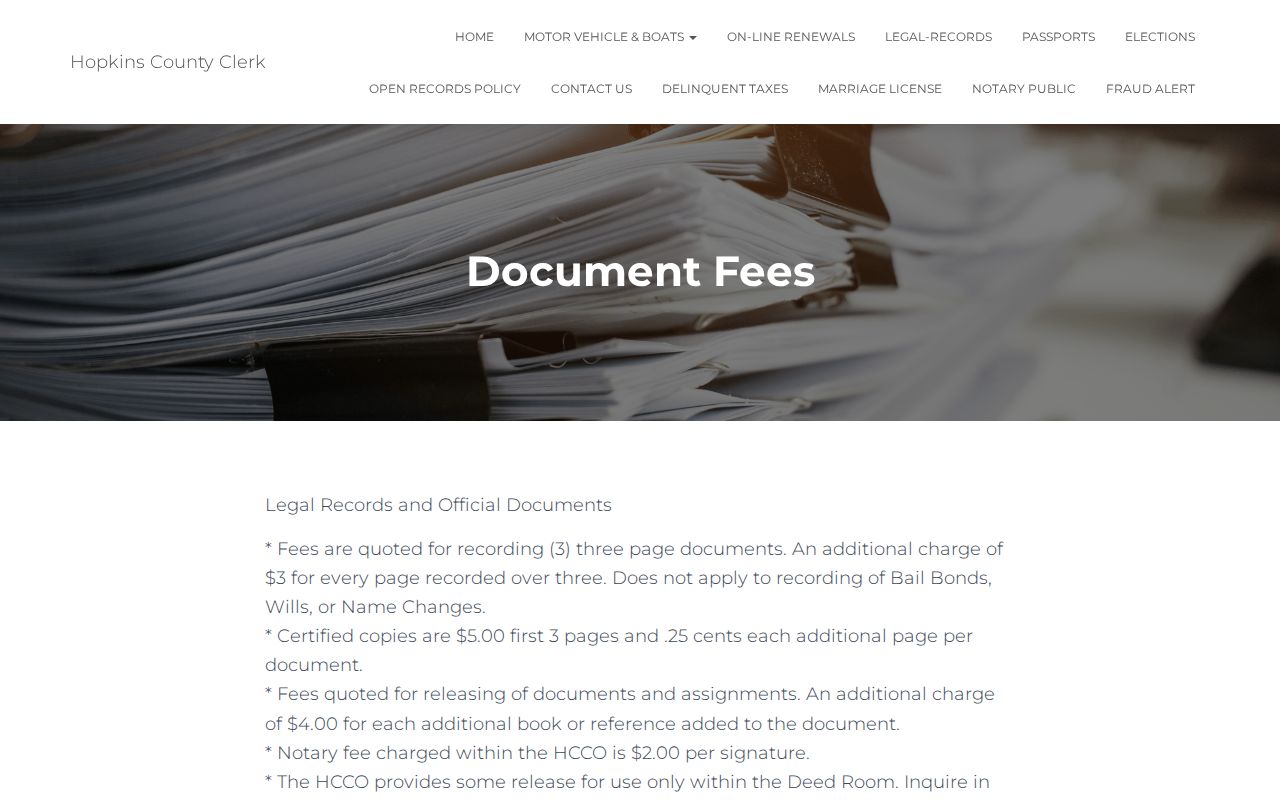
The posted page separates recording, copy, certification, notary, and release charges. That separation matters. It keeps an index-access price from being mistaken for the clerk's copy fee.
TitleSearcher advertised monthly access at $45 for a primary user. An additional user cost $20. Pay-as-you-go figures ran $5 for an initial search and $2 per image. Its “.25 cent” name-search wording is ambiguous, so confirm it at checkout. Images may arrive as PDF or TIFF.
A “Not Indexed” result carries a specific meaning. Under the vendor's terminology, the instrument has not been verified or certified. Preserve the result. Ask for the image or clerk copy. Then check parties and the land description rather than assuming the instrument does not exist.
Older deeds may live in deed books, grantor-grantee volumes, KDLA microfilm, tax rolls, probate files, directories, or newspapers. Deed books and grantor-grantee volumes are only part of that spread. The UK Hopkins County Gleaner inventory reaches back to 1885. State inventories also cover Madisonville and Earlington papers. Those sources bridge name and street changes. Still, the operative transfer must be confirmed in the deed records themselves.
Recorded is not the same as insured title. Hopkins County deed records show filed instruments. They do not resolve every unrecorded interest, boundary dispute, lien priority, or defect, and they are not a title opinion.