
What Hopkins County Property Tax Records Contain
Hopkins County property tax records live with several linked offices. The Hopkins County PVA values each parcel at fair cash value. Taxing districts then set the rates. The Hopkins County Sheriff bills and collects the current ad valorem tax. A shared online tax-account system ties many of these details together for one search. It is neither a deed nor a survey.
| Field | What It Shows | Where |
|---|---|---|
| Land, improvements and total assessment | The value components assigned for an assessment year | Hopkins County PVA |
| Owner and mailing address | The roll or bill recipient, which may differ from the situs | PVA and tax account |
| Exemption flags | Relief recognized on the assessment record | Hopkins County PVA |
| Bill and pay status | Current amount, discounts, penalties, paid or unpaid status | Sheriff and tax portal |
| Certificate or sale status | A later stage of delinquent-tax collection | Clerk and County Attorney |
The assessed value is not the last sale price. It reflects the PVA's opinion of value for a given assessment year. The tax bill then applies district rates and charges to that number. A deed, by contrast, may state consideration for a transfer. That figure carries its own date and purpose.
The PVA Assesses, but It Does Not Collect
Kentucky splits these duties on purpose. Knowing the split prevents a common Hopkins County property tax mistake. The PVA values land and anything permanently attached to it. Local taxing districts set the rates. The sheriff collects the current bill. Once a statutory delinquency handoff occurs, the county clerk and county attorney handle certificates of delinquency.
Square footage, land value, an improvement, an exemption, or the assessment date? Ask the PVA. Whether a current bill was paid, a discount, a penalty, or a receipt? Ask the sheriff. Certificate questions go to the clerk or to Hopkins County Attorney tax collection.
Note: A tax amount alone cannot establish a property's market value or its current legal owner.
Search the Hopkins County Tax Account
The Hopkins tax-account search offers unusually useful controls. Pick the right axis before typing, since “Mailing Address” follows the recipient while “Property Address” marks the physical site.
| Control | Choices or format | Best use |
|---|---|---|
| Search By | Account Number, Owner Name, Mailing Address, Owner Id, Property Address, Appraisal District Number, Statement Number, Legal Description | Choose one identifier |
| Account Type | All, Real, Business, Personal Property, Mineral, Commercial, Other | Limit a parcel inquiry to Real when needed |
| Inactive Accounts | Yes or No | Include older account history |
| Pay Status | Both, Paid, Unpaid | Separate balance status |
Enter account numbers with their dashes, as in 126-0586-00010. Names go last name first. The portal also allows a situs search. It notes that street type or direction can be left off. Follow these rules before assuming no account exists. The official tax-search screen shows how a Hopkins County property tax lookup is laid out.
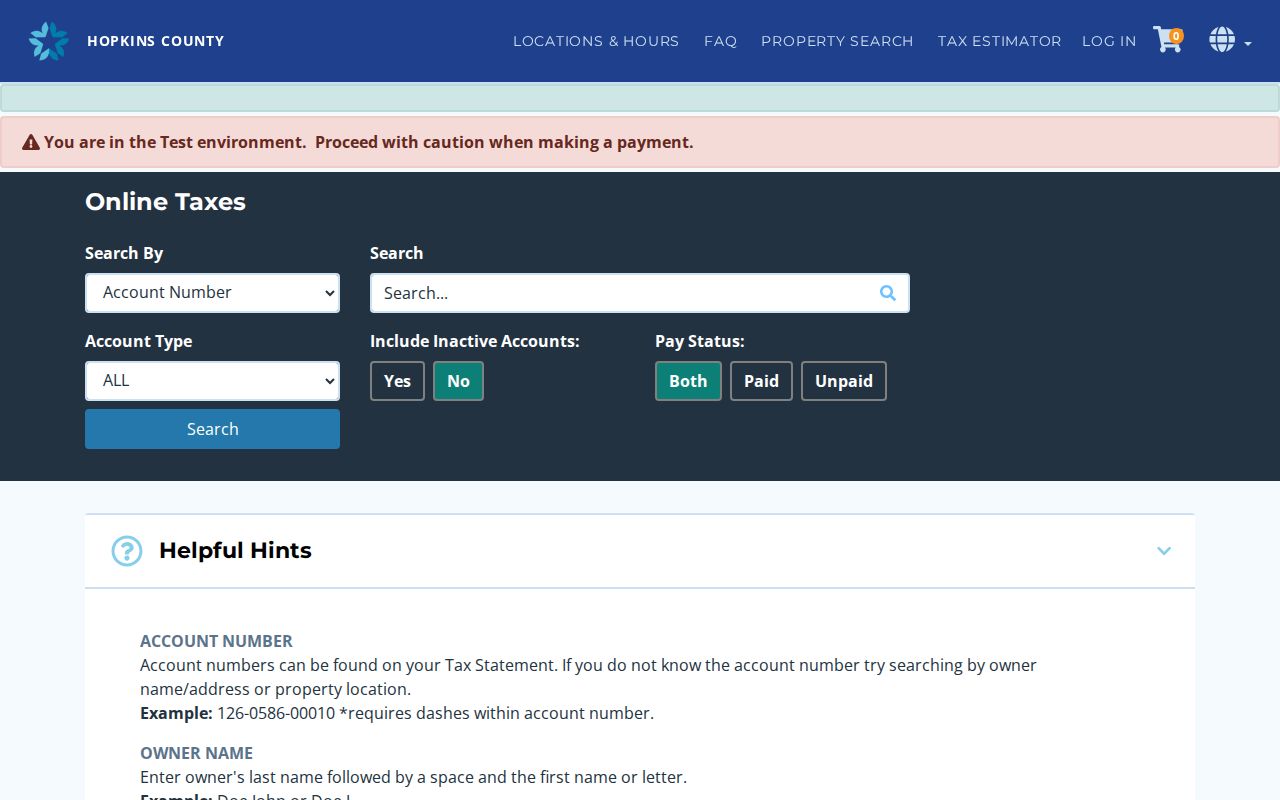
Treat the screen as a gateway only. When you record a result, keep the account number, tax year, query mode, and access date together.
Follow a Hopkins County Tax Bill from Parcel to Status
A careful search keeps parcel identity, assessment, and collection status distinct. An owner-name match alone proves little. Always confirm it against a map ID or the property address before trusting the tax bill.
- Search the tax portal by Property Address; note the account and map ID.
- Open the matching PVA material and record the assessment year, land, improvement, total, and exemption fields.
- Check the sheriff's current tax information for payment status, discount, penalty, and receipt questions.
- If unpaid after the collection period, check the clerk's delinquent list and ask the county attorney about the certificate.
- Assessed value
- The PVA's value for the stated year under Kentucky's fair-cash-value standard.
- Taxing rate or levy
- The rate applied by the relevant district, separate from the PVA's valuation work.
- Homestead exemption
- Assessment relief for a qualifying applicant and property, shown only after approval.
- Tax lien
- A claim securing unpaid property tax; its certificate status is not a deed.
January 1 Explains a Later Owner Mismatch
The sheriff cautions that each bill goes to the January 1 owner of record. A deed recorded later in the year may not appear on that bill. This is a timing gap, not proof of an error. A buyer sometimes receives a bill that still carries the seller's name. The buyer may instead have to forward one that does not. Current ownership can matter. In that case, check the newest deed on the Hopkins County Clerk legal-records page. Let the bill answer billing questions and the recorded conveyance answer title-transfer questions.
Owner-date quirk. A January 1 name on a tax bill may remain even though a later recorded deed transferred the parcel.
Read Hopkins County Delinquent Lists by Map ID
The clerk's delinquent-tax page posts dated lists, not a full ownership history. A 2024 PDF there ran 71 pages. Each entry carried the bill or asset number, the owner of record and mailing address, purchaser details where they applied, tax year, amount, map ID or location, and a run or due date. Treat any row as one moment in time.
Map IDs appear in forms like M-26-36-19, DS-7-2-16, and MADISONVILLE 196 M01. These strings link a delinquent bill to its parcel in the PVA and GIS systems. Copy them exactly. They are examples from real Hopkins County lists, not a published universal syntax.
The Hopkins County Clerk delinquent-tax page is where dated files and sale notices are routed, so it is the natural starting point for this kind of property search.
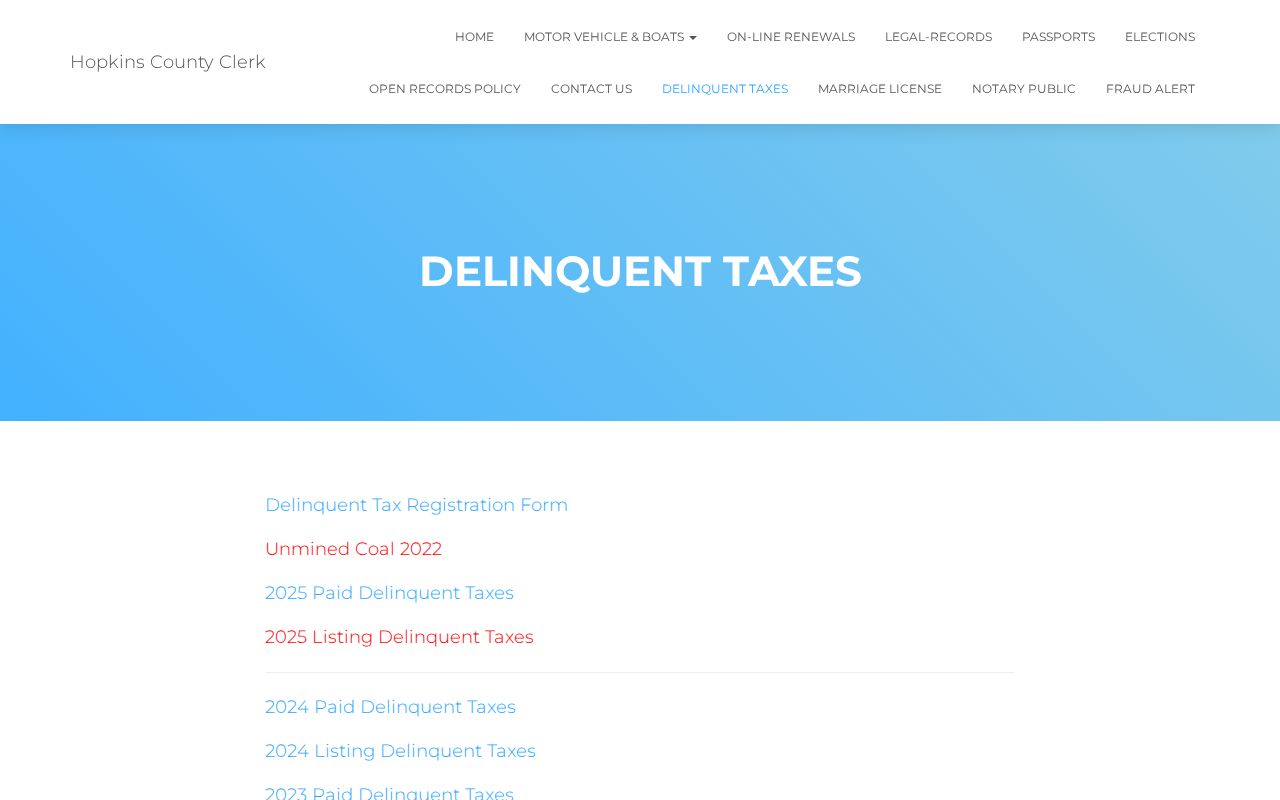
A published row is still just a snapshot. Someone may have paid after the list went out, so check the account again with the office before relying on it.
Do not confuse stages. A delinquent row or certificate is not automatically a foreclosure, deed, or proof of clear title.
Current Sheriff Collection and Later Certificates
The sheriff takes cash, checks, money orders, cashier's checks, cards, and online-check options. Convenience fees can attach to the electronic methods. Discounts and penalties shift across the collection cycle. Confirm the current amount and calendar with the office itself. Never assume partial payments are allowed.
Once April 15 passes, delinquent ad valorem accounts enter the KRS Chapter 134 process. Request the tax year, statement or bill number, and certificate number. Ask about the purchaser, the payment or redemption history, and who currently holds the account. That paper trail gives you an auditable Hopkins County property tax record. It beats a stale PDF.
Exemptions and Physical Review of Real Property
The PVA assesses land and anything permanently attached to it. Kentucky law calls for fair-cash-value assessment every year. A physical examination must happen at least once every four years under KRS 132.690. Beyond that cycle, the office picks up change clues elsewhere. Sources include city building-inspector permits, electrical inspections, manufactured-home transfers, park-owner lists, field measurements, photographs, and improvement specifications.
Ask the PVA for the right form and eligibility rules before pursuing an exemption. Note the assessment year. Note whether the exemption was approved. A mailing-address change only affects correspondence, never title. An approved exemption entry proves nothing about occupancy. It only reflects the rule and year it was granted under.
Note: Save the assessment year because values, exemption status, and physical-review evidence can change between rolls.
Contest a 2026 Hopkins County Assessment
The 2026 PVA calendar sets May 4 through May 18 for inspection and conference. Appeal filings are due May 20. Meeting with the PVA comes first. You cannot skip that step and go straight to an appeal. These dates repeat each year, so confirm the schedule before any later filing period.
Strong evidence pins down the parcel and compares similar property fairly. Bring the account or map ID and your assessment notice. Recent arm's-length sale material, photographs, measurements, repair records, and truly comparable sales all help. Keep a dated copy of everything you submit, along with any conference result.
Appeal window. For 2026, conference and inspection ran May 4–18 and the filing deadline was May 20; verify the PVA's current-year calendar before acting.