
Compare Three Hopkins County Property Value Figures
Name the figure, its purpose, and its record date before comparing. Hopkins County's PVA assesses real property at fair cash value. Deed consideration and a private appraisal answer different questions about the same parcel.
| Value Type | What It Means | Where It Is Recorded |
|---|---|---|
| Assessed value | The PVA's annual fair-cash-value assessment | PVA parcel and assessment record |
| Market-value opinion | An estimate for a stated date and purpose | A current appraisal, not the tax bill |
| Last sale price | Consideration shown for a recorded transfer, when meaningful | Deed or parcel sale-history field |
| Land and improvement values | Components that explain the total assessment | PVA record or office request |
Not every deed price reflects the open market. A family transfer, fiduciary deed, correction, or partial-interest conveyance can carry consideration that tells you nothing about what a willing buyer would pay. So read the deed type before trusting any price. Hold the parcel composition constant too, because a land split, combination, demolition, or exemption can make two annual totals look comparable when the account itself changed. Keep the map ID with each number. Add the legal-description clue and improvement status so the reason for a change can always be tested.
Read Hopkins County Assessed Value as Fair Cash Value
The Hopkins County PVA taxes land and attached structures. Fair cash value is the standard. KRS 132.690 requires annual assessment and a physical examination at least every four years. The standard serves assessment administration, not a forecast of the next sale price.
- Assessed value
- The value placed on the tax roll by the PVA.
- Fair cash value
- Kentucky's willing-buyer and willing-seller assessment concept.
- Consideration
- The value stated in connection with a deed transfer, when shown.
- Reassessment
- A new valuation review for a later cycle.
Keep the assessment year beside every number you copy. An old snapshot read as a live estimate is the fastest route to a bad comparison.
Separate Hopkins County Land and Improvement Value
Request land, improvement, and total assessed value by year. The PVA leans on permits and inspections. Additions, garages, multifamily work, pools, manufactured homes, electrical inspections, field measurements, photographs, and interior specifications all feed the assessment file. They can explain a value change without any sale.
Field names can change on the PVA's value-detail page. Verify the current labels before assuming a specific field appears online.
Treat permit data as supporting evidence only. Note the project type, application date, issued status, and inspection or completion result, tied to the assessment year the work first affects. A withdrawn or unfinished application explains nothing. Do not use it for an improvement figure without a final record.
Note: Physical-data records can explain an assessment change, but they do not replace a condition inspection or appraisal.
Look Up a Hopkins County Property Value Snapshot
Start with the Hopkins County PVA, the office responsible for assessment. Keep the parcel fixed while comparing.
- Search the situs address or map ID and verify the legal-description clue.
- Record the year and land, improvement, and total values shown.
- Note exemptions, sale history, inspection date, and deed reference where available.
- Compare deed consideration only after checking the transfer type and date.
- Save the source and access date with the value snapshot.
The tax-account portal accepts searches by Account Number, Owner Name, Mailing Address, Property Address, Appraisal District Number, Statement Number, and Legal Description. It works as a parcel cross-check. Assessment stays with the PVA. The official Hopkins tax-account search provides the live surface for matching an address to a map record.
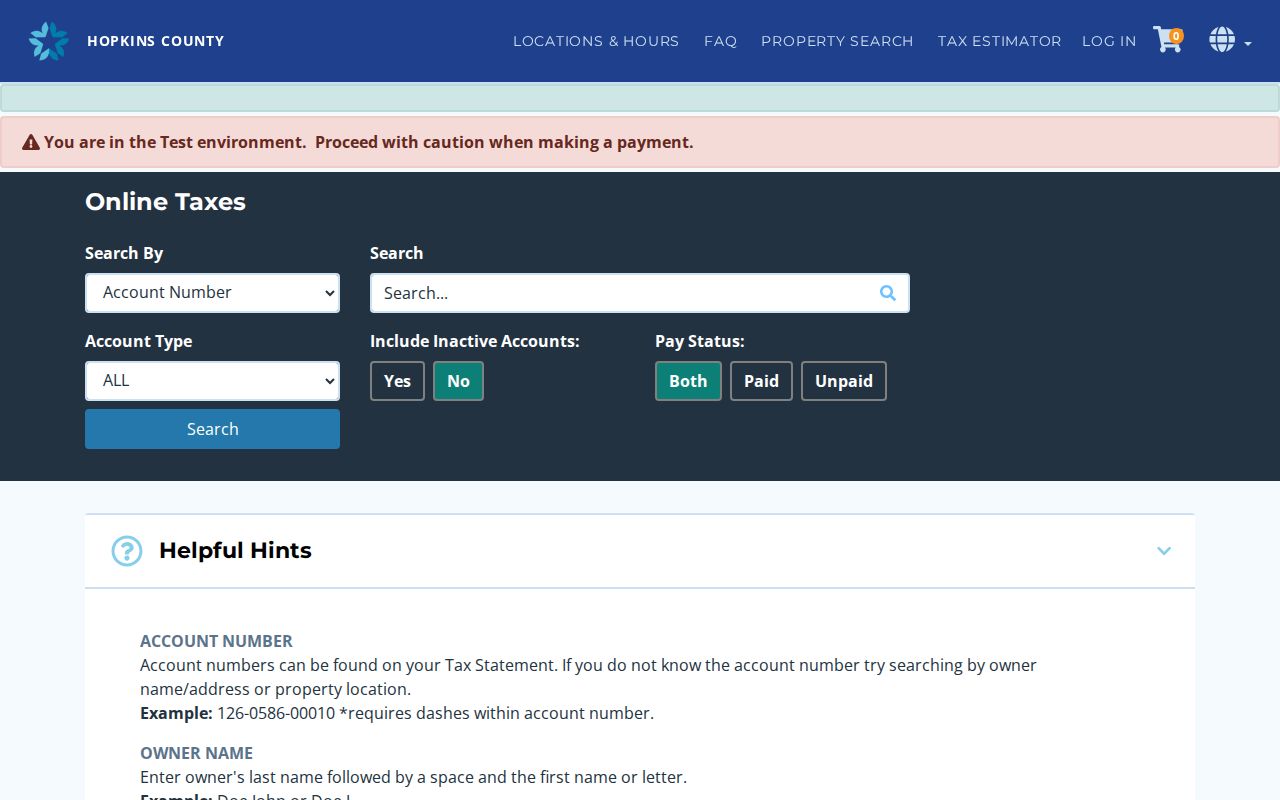
The filters confirm which parcel sits behind a value figure. The assessment itself remains the PVA's work.
Date Hopkins County Property Values to the Correct Snapshot
A Hopkins County tax bill goes to whoever owned the parcel on January 1. So it can lag behind a deed recorded later in the year. Track each date on its own line. The deed recording date, the January 1 assessment date, the physical inspection, the appeal window, the tax-bill issue, and the GIS map refresh all tell different stories. They describe the same parcel number. Put them in order and most apparent conflicts resolve themselves.
A new owner of record does not make an old appraisal current. A fresh sale does not rewrite every county database at once. The assessor, the recorder, and the GIS map each update on their own schedule. Keep the source of every number attached to that number. If the parcel was combined or split, start a fresh comparison series. The old values no longer describe the land the same way.
Test Hopkins County Sale Evidence Before Comparing Values
A recorder entry can expose consideration, document type, parties, date, instrument or book and page, legal description, and a prior-deed reference. Together they test whether a sale was truly open-market.
Some deeds deserve a second look. Trust, estate, commissioner, sheriff, correction, and quitclaim contexts rarely mirror the open market. Sale history is evidence, not an appraisal. A bare number without its deed type and parcel match can mislead a comparison.
Comparable sales need similar location, land use, lot size, improvement type, and effective date. The public record supplies leads. Not every negotiation condition gets recorded. Investigate each candidate sale first.
Note: A deed-index row is a lead; the instrument and property description provide the context needed to interpret consideration.
Save the 2026 Hopkins County Value Calendar as Dated Evidence
The PVA's official appeal material shows how assessment dates shift; in 2026, inspection and conference ran May 4 through May 18, with appeal filing due May 20. Those dates change annually. Check them again for any later cycle.
Beyond valuation, the questions turn to taxes. Bill, exemption, and appeal procedure details belong in the Hopkins County property tax records guide.
Know What Hopkins County Property Value Records Cannot Prove
An appraisal in Hopkins County property records answers a narrow question. It states what the tax roll says a parcel is worth. It cannot speak to hidden defects, current condition, or exact replacement cost. Nor does it capture buyer motivation. It also cannot say what a bidder might offer at a future sale. Treat these values as a way to frame questions and compare dated sources. Do not treat them as a promise of any sale result.
Value versus price. A Hopkins County assessed value serves the property-tax system. It is not a sale guarantee or a current appraisal.